Model Rocket Kits for Beginners: Family Launch Day Fun
Blast Off with Beginner-Friendly Rockets
Ready for liftoff? Model rocket kits for beginners offer families an explosive blend of science and adventure! There's something magical about watching a rocket you built with your own hands soar into the sky. That moment when the engine ignites and your creation transforms from a tabletop project to an airborne wonder creates memories that last a lifetime.
Whether you're shopping for a budding astronaut or looking for a weekend activity that finally pulls kids away from screens, beginner rocket kits deliver sky-high excitement. Best of all, you don’t need engineering skills or special tools. Today’s starter kits make rocketry accessible to families with everything you need to assemble and launch safely.
Let’s explore how these pocket-sized rockets can turn your backyard into a mini mission control!

Choosing Your First Flight
Stepping into the world of model rocketry can feel overwhelming, but manufacturers make it easier with clear product categories. The two most common types for beginners are:
Ready-to-Launch Kits
Perfect for first-timers who want instant gratification:
- Minimal assembly (usually under 30 minutes)
- Pre-colored parts that snap together
- Great for younger kids or families short on time
- Typically priced $15–30
These offer the fastest path from box to blastoff.
Build-from-Scratch Kits
For families who enjoy the crafting process:
- 1–3 hours of enjoyable, hands-on building
- Requires simple tools and glue
- Lets kids personalize their rocket with paint and decals
- Creates a stronger sense of ownership
- Usually $20–45
These are best for ages 10+ with adult supervision, per manufacturer guidelines.
Recommended Starter Kits

Two of the most popular entry-level sets are:
-
Estes Tandem-X Starter Set (includes rockets, pad, and controller — but engines must be purchased separately)
-
Quest Astra III Starter Set (sometimes includes engines depending on the retailer — always check the listing)
Both offer approachable builds with exciting flight performance.
And remember: building the rocket together is half the fun! Many families find that the teamwork and creativity during assembly make for some of their favorite moments.
The Science Behind the Whoosh
Model rocketry brings STEM concepts to life in a way textbooks simply can’t. Kids absorb real science while having real fun.
Sneaky STEM Skills Your Kids Will Pick Up
Physics
- Newton’s Laws of Motion become instantly understandable when a rocket lifts off
- Thrust, drag, and momentum turn into visible, real forces
- Predicting the landing spot becomes an applied trajectory calculation
Engineering
- Aerodynamics and stability matter — and kids see why
- Trial-and-error troubleshooting builds genuine problem-solving skills
- Material choices become important when shaping fins and body tubes
Math
- Measuring components precisely
- Tracking altitude based on flight time
- Estimating drift distance based on wind speed
Even if your child doesn’t know velocity formulas yet, they’ll naturally understand that a heavier rocket needs a stronger engine to reach similar heights.
Many parents report a noticeable increase in their kids’ interest in science after they experience their first launch.
Launch Day Essentials
Your rocket is ready — now it’s time for launch! A safe, successful flight starts with the right preparation.
Safe Launch Site Guidelines
According to the National Association of Rocketry (NAR), launch in an open area that meets minimum size requirements based on engine power:
- A engines: ~100–200 ft minimum
- B engines: ~300 ft
- C engines: 500 ft minimum
- D engines: ~1,000 ft
These distances ensure safe liftoff and easier recovery.
Great locations include empty school athletic fields, large parks, or open farmland (where permitted).
Pre-Launch Checklist
- Never modify rocket motors or use homemade propellants
- Ensure the launch rod is stable and no more than 30° from vertical, per NAR safety rules
- Keep spectators at least 15 feet away
- Have a fire extinguisher, sand, or water nearby
- Use only flame-resistant recovery wadding (never tissue paper)
- Assign an adult as “range safety officer” to oversee countdowns
Weather Considerations
- Avoid launches in winds above 10 mph (drift increases dramatically)
- Never launch during thunderstorms or when lightning is nearby
- Ensure cloud cover is high enough to maintain visual contact
Recovery & Repeat Flights
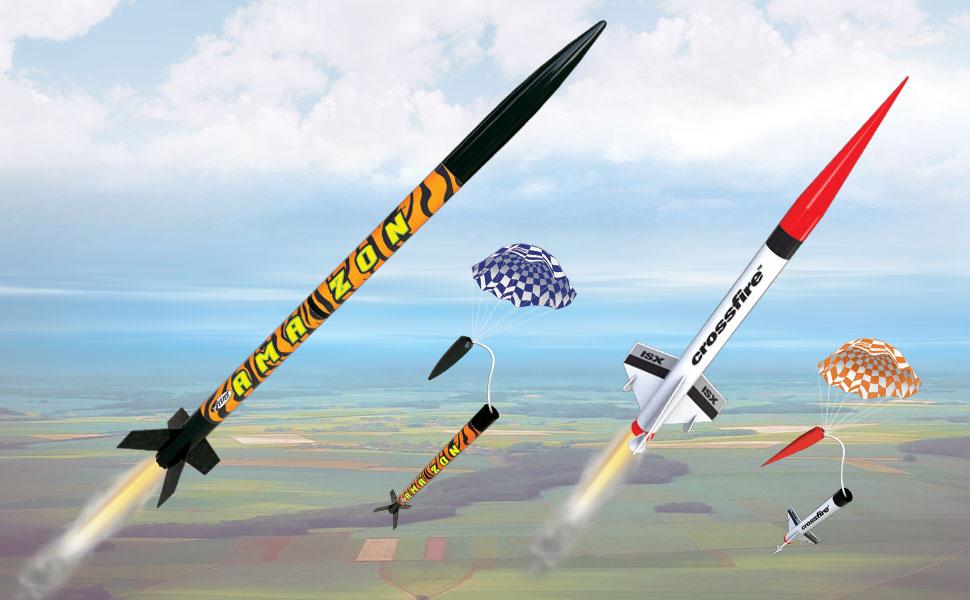
Most beginner rockets use either:
- Parachutes — slow descent, maximum hang-time, may drift farther
- Streamers — less drift than parachutes, better for smaller fields, though still wind-sensitive
After retrieval:
- Inspect for damage
- Make quick repairs with glue or clear tape
- Reload and launch again — most beginner rockets are designed for multiple flights in one session
- Bring extra igniters; they fail occasionally
Building Your Rocket Collection
After your first launch, you’ll almost certainly want more. A typical progression looks like:
- Single-stage rockets (beginner)
- Cluster or booster-assisted rockets (intermediate)
- Multi-stage rockets (intermediate to advanced; require much larger launch areas)
- Specialty rockets with glider recovery or creative shapes
Local rocketry clubs are incredibly welcoming and often host monthly launches. Experienced rocketeers love helping families get started.
Creating Lasting Memories Among the Stars
Model rocket kits for beginners aren’t just educational toys — they’re memory-makers. In a digital world, few activities are as engaging, connective, and awe-inspiring as building and launching a rocket together.
The countdown, the ignition, the gasp as it streaks skyward, and the search party that follows — every moment strengthens family bonds. These are the stories kids remember forever:
- “Remember when our first rocket landed behind the bleachers?”
- “Or the time our parachute caught the wind and drifted all the way to the baseball field?”
With many starter kits costing less than a family movie night, the excitement-per-dollar ratio is off the charts.
So gather your crew, pick your first rocket, and prepare for liftoff into a new family tradition packed with science, adventure, and unforgettable memories.